Live Proctoring vs Automated Proctoring, What’s the Difference?
Online exams need fair and secure ways to confirm that students have completed their assessment without cheating. Two methods are human-supervised monitoring and technology-based monitoring. Each method can support academic integrity, but they differ in how they observe students, handle unusual behaviors, and review policies. The choice between the two types of proctoring systems may differ in the student’s experience, staffing needs, privacy, cost, and flexibility.
By comparing live proctoring vs automated proctoring, including human oversight, artificial intelligence, monitoring tools, scalability, and review practices, institutions can choose a method that matches the purpose and risk level of online examination.
Live Proctoring Vs Automated Proctoring: Key Difference
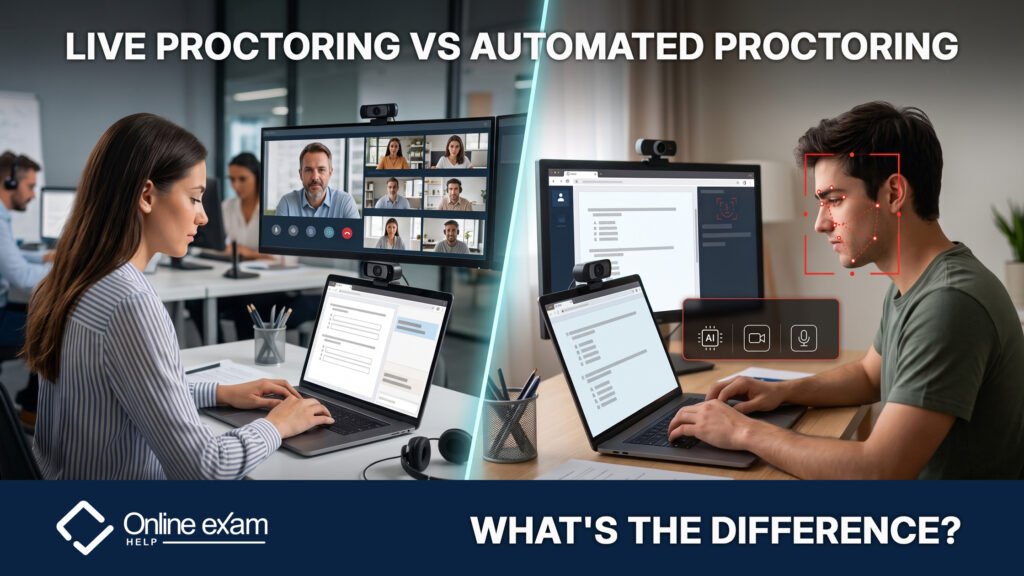
The main difference between live proctoring vs automated proctoring is who monitors the exam. In live proctoring, throughout the test, a human proctor keeps an eye on the student and can react if anything out of the ordinary occurs. Software is used in the automated approach to log activities and mark occurrences for examination. There are fixed rules for each online proctoring software. While software adheres to preprogrammed rules or models, humans are able to take context into account.
Exam integrity is the goal of both strategies, but they have distinct requirements for student assistance, personnel, technology, scheduling, and privacy. Students who are thinking to go for the “Take my exam for me” option must know the difference between these two proctoring types.
How Live Proctoring Works?
Identity verification and an environment check are often the first steps in live proctoring. Now the question is what does a proctor do? The proctor may request that the student keep the webcam running, demonstrate the desk area, and ensure that the items are allowed. The proctor observes the student during the test and may keep an eye on screen activities.
The proctor may record the incident or pose questions if a problem arises. This instantaneous communication can assist in differentiating between real issues and suspicious motions or technical disruptions.
How Automated Proctoring Works?
Now, getting to what is online proctor exam is, it is the type of proctoring where there is no need of a human supervisor, and AI covers the entire exam time. With minimal real-time human observation, automated proctoring leverages technology to keep an eye on an assessment session. Depending on how it is built, the system can record audio, video, screen activity, browser behavior, and other signals.
This technology may identify anomalous occurrences by using artificial intelligence or rules. Misconduct is not always proven by a flag. Before making a final judgment, institutions should examine the pertinent data and implement their academic integrity policy.
Automated Online Proctoring & AI Proctoring
This technology can enable large-scale evaluations because software may monitor many sessions concurrently. Patterns like extra faces, surprising sounds, strange actions, or efforts to access resources that are banned can all be analyzed by AI proctoring.
Automated online proctoring, however, sometimes lacks context. A student may have a good cause for quickly averting their gaze. When a machine detects an occurrence that has several possible explanations, human evaluation is still helpful.
Remote Proctoring for Different Exams
While maintaining monitoring standards, this method enables students to finish tests outside of a regular testing facility. If a student is giving “Take my pmp exam” or other standardized exams such as GED or HESI, online proctoring has become an important part of it. Students who live far from college or want flexible testing schedules may benefit from remote exam proctoring. It could make use of automated tools or human oversight.
To help students comprehend the regulations and minimize avoidable disruptions, institutions should specify the equipment requirements, room conditions, permissible items, and technical processes prior to the test.
Remote Exam Proctoring & Student’s Experience
The experience of remote exam proctoring may vary based on the monitoring technique used. Certain students favor conversing with a person as they can obtain instant clarification. Some individuals might favor automated monitoring as it doesn’t require them to engage with a proctor during the session.
Both approaches can induce stress if students are unclear about the guidelines. So, students should be aware of the online proctored exam rules. Training sessions, straightforward guidelines, and available technical assistance can simplify the assessment process.
Privacy & Online Proctoring Software
Organizations need to analyze what data the software gathers and its process for managing that information. Depending on the platform, information may consist of identity details, recordings, screen activity, audio, or browser data. Students must be provided with explicit privacy details prior to testing.
Organizations should likewise implement suitable retention, access, and security measures. Expectations of privacy may vary based on the location and institution, necessitating that organizations adhere to relevant laws and their own guidelines.
Which Method Fits the Best?
No single method is ideal for all evaluations. So, if students ask among live proctoring vs automated proctoring, which one is best? In-person monitoring might be ideal for high-stakes assessments needing careful human evaluation, while automated systems can assist organizations in handling large student populations. These tools can aid in detection, but organizations should not consider automated alerts as conclusive evidence of misconduct.
A unified model can employ software to detect events and trained personnel to examine them. The appropriate decision hinges on exam risk, available resources, student requirements, and institutional obligations.
Conclusion:
Choosing between live proctoring vs automated proctoring requires more than comparing human supervision with software. Institutions must evaluate the exam’s significance, the number of candidates, available personnel, technical needs, privacy obligations, and the review procedure. Human oversight delivers direct evaluation, whereas automated systems ensure scalability and uniform technical assessments.
Both live proctoring vs automated proctoring approaches do not eliminate the necessity for transparent guidelines and just judgments. An effective assessment process outlines monitoring practices beforehand, offers students suitable technical support, and establishes a method for evaluating disputed events.
FAQS
What does automated proctoring mean?
It means that software employs set checks like video, audio, screen activity, identity verification, or behavior analysis. Unusual events might be marked for future examination.
What does a live proctored exam mean?
A human supervisor observes the candidate throughout the test, typically via a webcam and associated technology. The proctor can confirm identity, examine the testing surroundings, watch behaviors, and intervene if necessary.
Can online proctoring see your screen?
Usually, yes, if screen tracking is activated. Certain systems may also utilize secure browsers to limit access to additional applications. The specific permissions are determined by the evaluation setup.
Can an online proctored exam detect a phone?
Certain systems can detect phone usage via camera perspectives, environmental tracking, AI-driven assessments, or human supervision. Detection relies on the technology and configurations chosen for that assessment.